Public engagement
Engagement
Bringing particle physics to public, civic, school and policy audiences — and leading engagement strategy for one of the world's largest scientific collaborations.
Leadership roles
- 2024–Associate Dean for Engagement (public, civic and schools), Faculty of Science & Engineering, University of Manchester — strategic leadership of the Faculty's public, civic and outreach engagement.
- 2026–Chair, Manchester Leadership Group for the British Science Festival 2027; member of the British Science Association BSF Steering Group.
- 2026–Member, Jodrell Bank Centre for Engagement (JBCE) Programme Advisory Board.
- 2025–Member, University of Manchester Public & Civic Engagement Group.
- 2019–Scientific expert and guide, New Scientist "Discovery Tours" — multi-day public tours with lectures, discussion sessions and visits to CERN's experimental facilities.
- 2018–20Public-engagement strategy advisory roles at the Institute of Physics and STFC.
- 2022–24ATLAS Education & Outreach Coordinator, CERN — elected on the votes of 181 collaborating institutes, with strategic oversight of all of ATLAS's education and outreach. The role hosted more than 50,000 visitors a year and reached millions online, coordinating content across atlas.cern and reporting to the ATLAS spokesperson.
- 2017–20UK representative on the Collaboration Board of the International Particle Physics Outreach Group (IPPOG).
Public engagement & outreach
I am currently leading the organisation of the British Science Festival 2027 as Chair of the Manchester Leadership Group — one of the UK's largest public science festivals. Alongside this I sustain a broad, ongoing programme of public, schools and civic engagement:
- Official CERN guide for the public — hosting VIP visits and meeting MPs, AMs, diplomats and heads of state.
- Organiser of the annual Manchester Schools Particle Physics Masterclass, reaching hundreds of A-level students a year and expanding to widening-participation audiences.
- Registered STEM Ambassador; exhibitor and demonstrator at the Manchester Science Festival, the Big Bang Fair, Science Uncovered (European Researchers' Night) and the Royal Society Summer Science Exhibition.
- Invited lecturer at teacher-development sessions in the UK and abroad — including the Institute for Research in Schools and courses at CERN — and a frequent visitor for school talks and careers Q&As.
Selected highlights over the years
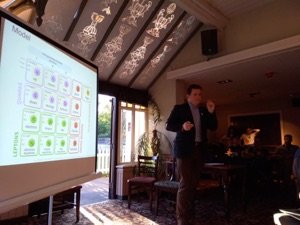
Pint of Science 2018. I gave a talk, "The invisible plan: shedding light on dark matter", as part of the Manchester Pint of Science Festival — taking front-line research into a pub for a general audience.
'Collider' exhibit, Science and Industry Museum, Manchester (2014). I spoke with the public across a wide range of ages and backgrounds about particle physics and the LHC, providing context and conversation around the exhibit.
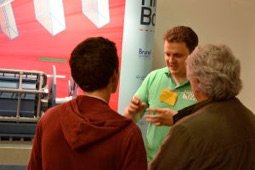
Royal Society Summer Science Exhibition. Exhibitor and demonstrator at the Royal Society's flagship public exhibition and its satellite events.
Earlier engagement has included the Trafford Schools Ogden Trust Study Day (2019); the STFC LHC Roadshow at the Senedd in Cardiff and the Welsh Particle Physics Masterclass (2015); a CERN visit for UK MPs and AMs (2017); the Science Uncovered event at Manchester Museum (2016); the Big Bang Fair and Manchester Science Festival across several years; and teacher-development work for the Institute for Research in Schools and at CERN — among many more school visits, public lectures and Q&A events across the UK and abroad. This is far from an exhaustive list.
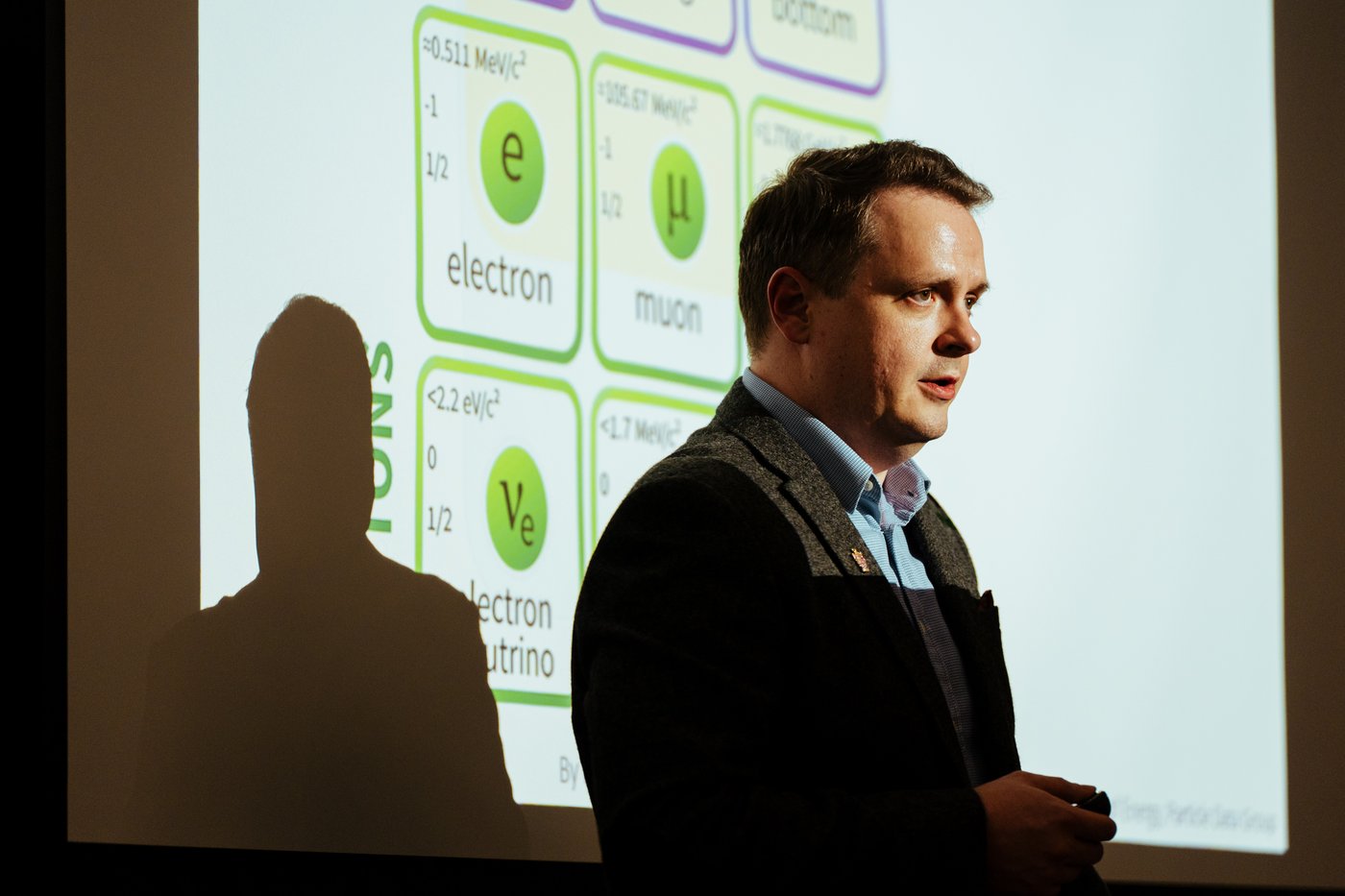
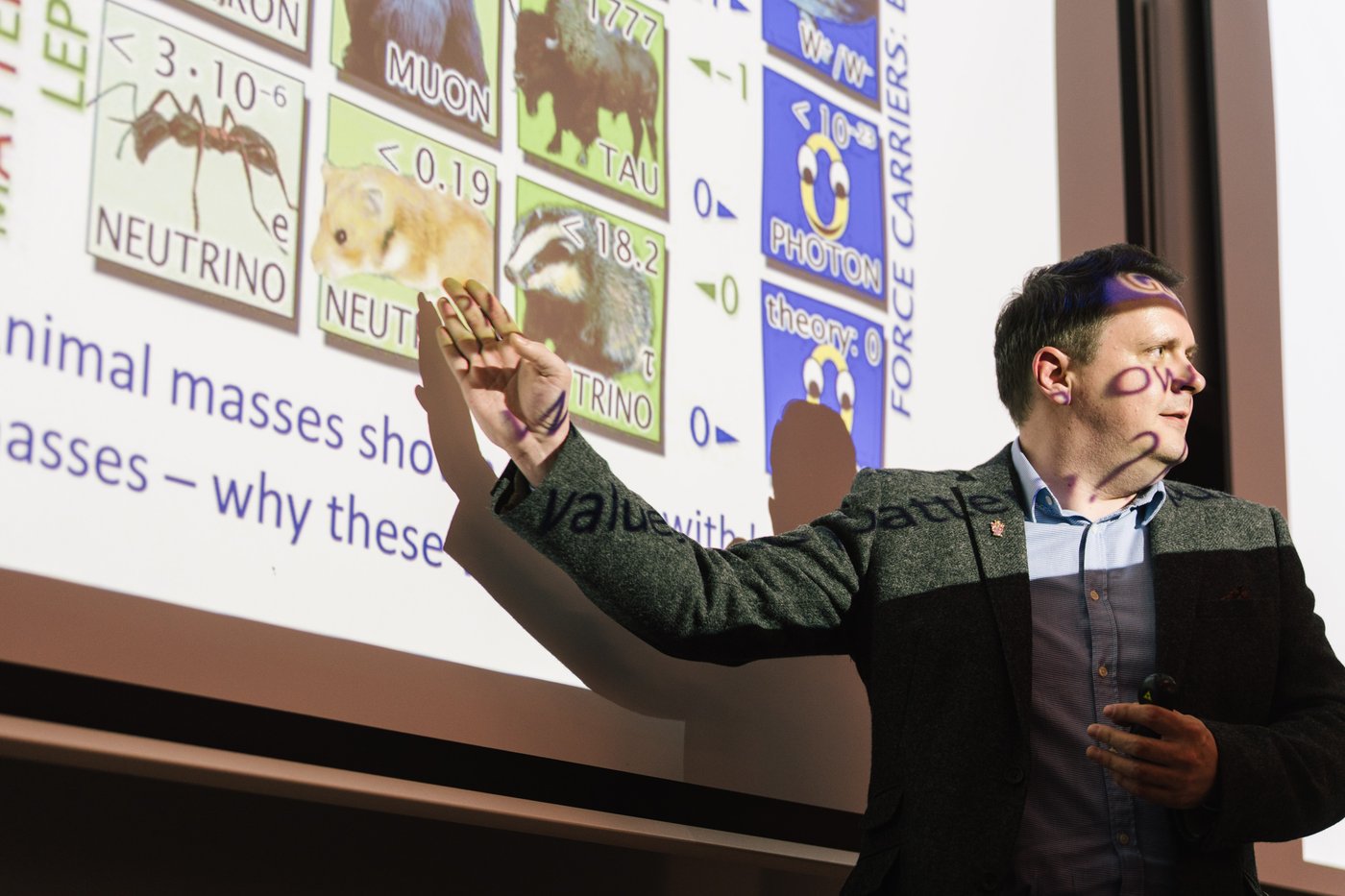
Media
I founded and ran the Manchester particle-physics group's social presence (@UoMparticle, ~0.5M views/year) and posted on science and science communication from @darrenprice. I take part regularly in radio and newspaper interviews, and for BBC Radio have contributed to science programming and comedy/entertainment shows and provided expert input on scripts. In 2022 I coordinated ATLAS's contributions to the LHC Run-3 start-up media event, and I joined "The Agenda" on Dubai Eye 1038 to discuss the restart of the Large Hadron Collider.
For broadcast, press and commentary, see media enquiries.
Interactive tools
I build browser-based pedagogical tools that let anyone explore the physics of dark-matter detection directly — no installation, no maths prerequisites.
- The sensitivity explorer — "How do we hunt for dark matter?" Build your own experiment by dialling in target, exposure, energy thresholds, background and detector depth, and watch your 90% C.L. sensitivity curve move live against published results from CRESST-III, DarkSide-50, PandaX-4T, LZ and DarkSide-20k, and against the neutrino fog.
- The recoil explorer — "What does dark matter look like in a detector?" Given a hypothetical dark-matter particle, see the flux through your hand, the halo velocity distribution, the nuclear-recoil spectrum a detector records, and a Poisson “run the experiment” toy that turns expected counts into real, fluctuating data — so a single event never gets confused with a discovery.