Research
Research
Eight themes, spanning collider physics and direct detection, joined up by phenomenology, instrumentation and data-intensive methods. Explore each theme, or browse the full publications, talks, and news.
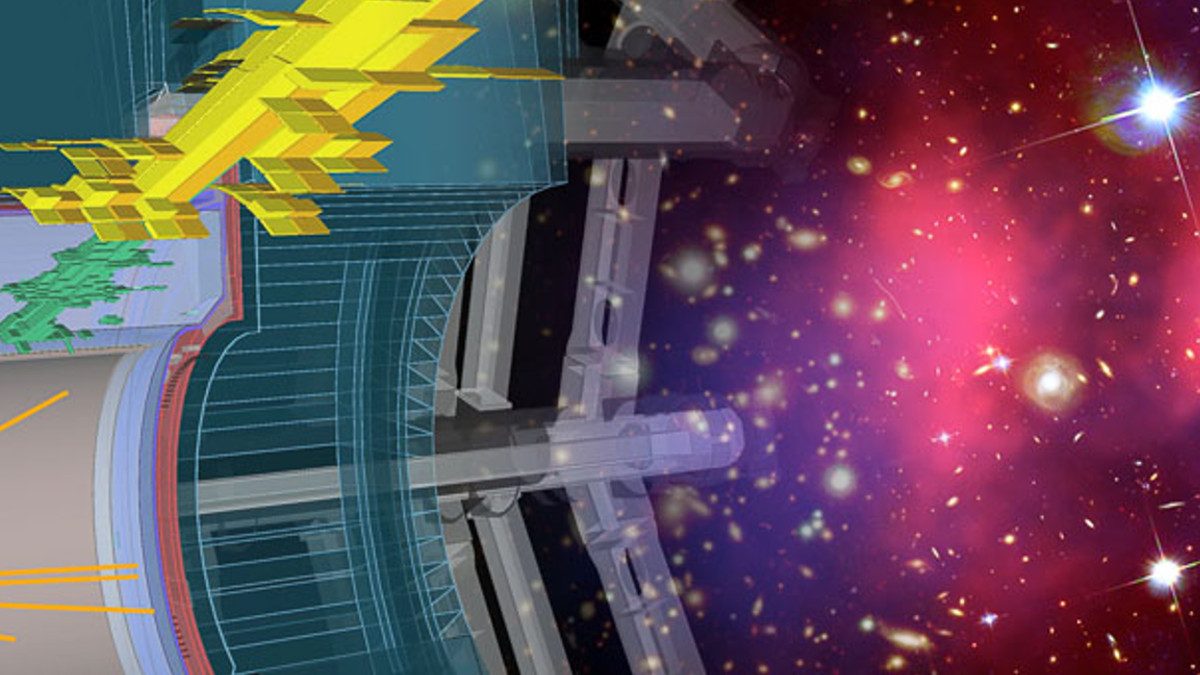
Research themes
Dark matter
Direct detection with the DarkSide argon programme and dark-matter searches at the LHC, joined up through phenomenology that maps models onto what different detectors actually see.
Explore →Electroweak physics
Weak boson fusion and scattering, anomalous gauge couplings and precision electroweak measurements as a laboratory for new phenomena.
Explore →QCD
Strong-interaction physics from vector-boson + heavy-flavour production to double parton scattering and jet physics at hadron colliders.
Explore →B-physics & quarkonium
Heavy-flavour spectroscopy — including the first new particle found at the LHC — rare decays, and CP-violation in the B-meson system.
Explore →Neutrinos
Heavy Majorana and sterile-neutrino searches at colliders, a heritage in neutrinoless double-beta decay, and coherent neutrino scattering with argon detectors.
Explore →Instrumentation
Cryogenic silicon photosensors and low-radioactivity readout electronics for next-generation rare-event searches, plus detector performance work.
Explore →Levitating sensors
Opto-mechanical levitated quantum sensors as an emerging route to ultra-low-threshold dark-matter detection — spanning instrumentation, dark matter and gravitational-wave sensing.
Explore →AI / Machine learning
Machine-learning methods for scientific discovery in the physical sciences — expressive generative models, simulation, inference and tools that let AI act as a collaborator in physics analyses.
Explore →Full publication record at INSPIRE-HEP.