Heavy Majorana and sterile-neutrino searches at colliders, a heritage in neutrinoless double-beta decay, and coherent neutrino scattering with argon detectors.
Neutrinos are the Standard Model's most elusive particles — and among the most
promising places to find cracks in it. Whether neutrinos are their own
antiparticles, and how they acquire mass, remain open questions.
Key areas
I work on searches for heavy Majorana and sterile neutrinos at colliders,
including through same-sign WW scattering — a channel uniquely sensitive to
lepton-number violation. My research career began with neutrinoless
double-beta decay on the SuperNEMO experiment, and that thread continues today.
Active now
With dual-target argon detectors we can study coherent elastic
neutrino-nucleus scattering (CEνNS) and beyond-Standard-Model neutrino
physics, complementing the dark-matter programme — including sensitivity to
supernova neutrinos with DarkSide-20k.
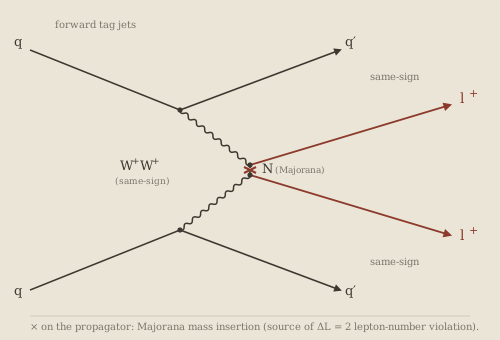
Feynman-style schematic. Two incoming quarks radiate same-sign W bosons that meet at a Majorana neutrino N; the Majorana mass insertion (×) violates lepton number by two units, allowing the final state to carry two same-sign leptons.
Same-sign WW scattering is a rare, purely-electroweak process that uniquely tests whether neutrinos are their own antiparticles — at high momentum transfer it is essentially a collider realisation of neutrinoless double-beta decay. This search uses the full ATLAS Run 2 dataset (140 fb⁻¹) in the same-sign dimuon channel to look for heavy Majorana neutrinos with masses from 50 GeV to 20 TeV, pushing the reach past the TeV barrier where resonant production becomes kinematically inaccessible. The results are interpreted in the Phenomenological Type-I Seesaw; a discovery would establish lepton-number violation.
Diverse interests across particle physics, software development and data analysis at colliders and in direct dark matter detection, high-frequency gravitational waves, neutrino physics, phenomenology, instrumentation, and the deployment of AI techniques.
Dark matterDarkSideInstrumentationLevitating sensorsNeutrinosCollider physicsML/AI
Advancing direct detection frontiers for dark matter, new neutrino physics and high-frequency gravitational waves through detector modelling, optimisation and novel sensor technologies.