
Research theme

Dark matter

Direct detection with the DarkSide argon programme and dark-matter searches at the LHC, joined up through phenomenology that maps models onto what different detectors actually see.

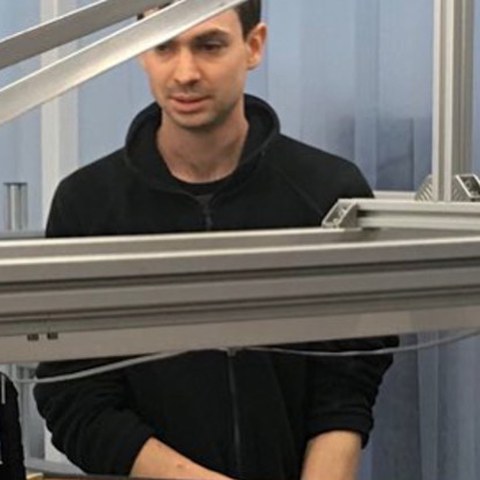
Darren in front of the DarkSide-20k veto vessel during assembly
DarkSide-20k veto vessel during construction at LNGS, Italy.

Dark matter makes up most of the matter in the Universe, yet it has never been seen directly. I attack the problem from two directions at once — trying to produce it in high-energy collisions at the LHC, and waiting for it to strike a detector deep underground — and tie the two together with phenomenology that maps models onto what each kind of experiment actually sees.

Key areas

At the LHC, I pioneered detector-corrected ("unfolded") measurements of missing-momentum-plus-jets final states that can be reinterpreted against many dark-matter models long after publication, and worked on searches for dark matter produced alongside b-quarks.

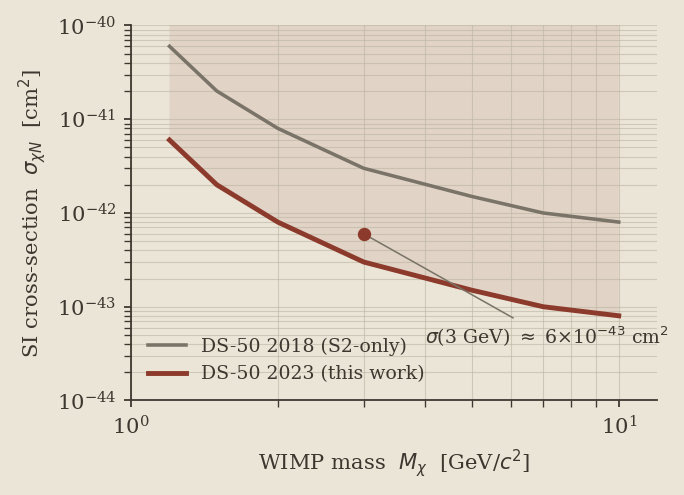
In direct detection, I established Manchester's role in the DarkSide argon programme. DarkSide-50 has delivered world-leading limits on low-mass WIMPs, and probed the Migdal effect and electron-recoil channels to reach lighter dark matter than nuclear recoils allow.

In phenomenology, my group studies target complementarity and isospin-violating dark matter — how combining argon, xenon and other detector materials breaks degeneracies and sharpens the interpretation of results across the field.

Active now

DarkSide-20k is under construction at the Gran Sasso laboratory, with Manchester leading on its silicon photosensors. Alongside it we are running design and sensitivity studies for a dedicated low-mass argon experiment, and developing new methods to reinterpret collider data against the full space of dark-matter models.

Try it yourself

Interactive · Pedagogical tool

How do we hunt for dark matter?

Build your own dark-matter experiment in the browser. Slide the energy thresholds, exposure, intrinsic background and detector depth, and watch your sensitivity curve move against the world-leading limits from DarkSide-50, LZ and DarkSide-20k. The plot pins to the top of the screen while you adjust controls, so every tweak is visible live. Mobile-friendly, with swipeable low-mass and high-mass panes.

Open the explorer →

Interactive · Pedagogical tool

What does dark matter look like in a detector?

A companion tool that looks at the other end of the problem: what actually arrives. Set the dark-matter particle's mass, cross-section and the local halo, pick a target nucleus, and watch the flux through your hand, the spread of halo speeds, and the nuclear-recoil spectrum a detector records. A "run the experiment" toy turns the expected counts into real Poisson fluctuations — a reminder that one event is never a discovery. Beginner and advanced modes; mobile-friendly.

Open the explorer →
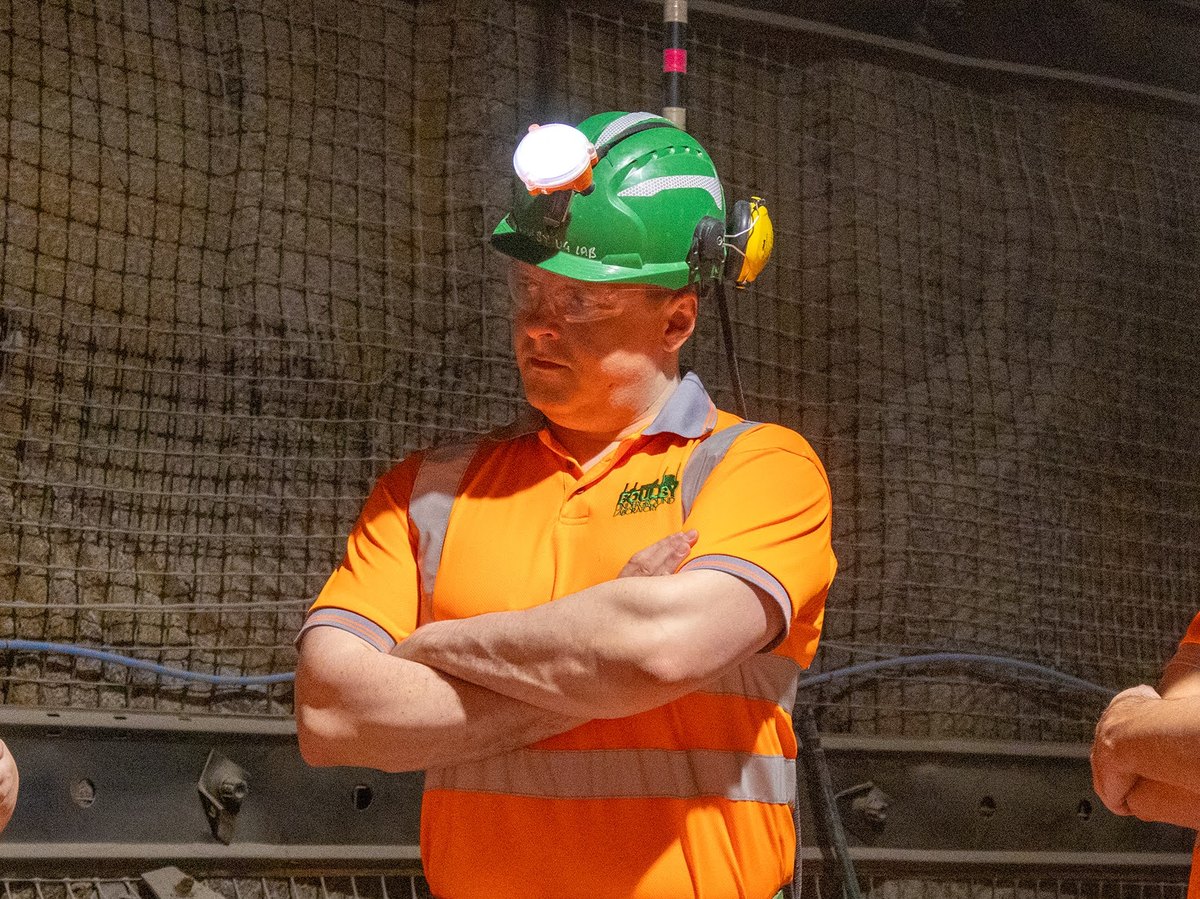
Visiting the Boulby Underground Laboratory
Boulby Underground Laboratory, 1,100 m beneath the North Sea — host site for the proposed DarkSide-LowMass detector.

All publications →


All presentations →


Current

Prof. Darren Price

Prof. Darren Price

Principal Investigator

Diverse interests across particle physics, software development and data analysis at colliders and in direct dark matter detection, high-frequency gravitational waves, neutrino physics, phenomenology, instrumentation, and the deployment of AI techniques.

Dark matterDarkSideInstrumentationLevitating sensorsNeutrinosCollider physicsML/AI

Dr. Ash Ritchie-Yates

Dr. Ash Ritchie-Yates

Particle Astrophysics Postdoctoral Research Fellow

Instrumentation development for direct dark matter searches.

DarkSideLevitating sensorsInstrumentation
Graham Miller

Graham Miller

Engineer

SiPM sensor assembly, metrology, and testing for the neutron veto system of the DarkSide experiment.

DarkSideInstrumentation
Rob Chapple

Rob Chapple

Engineer

Development of handling and shipping systems and processes for DarkSide-20k sensors.

DarkSideInstrumentation
Saulė Pigulevičiūtė

Saulė Pigulevičiūtė

PhD student (2025–)

Advancing spin-dependent dark matter searches with DarkSide-20k through detector instrumentation, sensitivity studies and sidereal analyses.

DarkSideInstrumentationPhenomenology
Haoxiang Zhan

Haoxiang Zhan

PhD student (2025–)

Advancing the discovery potential of liquid argon dark matter detectors through detector commissioning, calibration and novel sensitivity studies.

PhenomenologyDarkSideInstrumentation
Andrzej Gawdzik

Andrzej Gawdzik

PhD student (2023–)

Advancing direct detection frontiers for dark matter, new neutrino physics and high-frequency gravitational waves through detector modelling, optimisation and novel sensor technologies.

PhenomenologyDarkSideNeutrinosLevitating sensorsML/AI
Conner Roberts

Conner Roberts

PhD student (2021–)

Silicon photosensor instrumentation for next-generation dark matter searches.

DarkSideInstrumentation
Hayden Casey

Hayden Casey

MPhil student

Sensitivity studies for beyond-the-Standard-Model low-energy solar CEνNS anomalies with low-threshold dual-phase liquid-argon TPCs.

DarkSideNeutrinos
David Crofts

David Crofts

MPhys student (2025–26)

A muon cosmic-ray detector and mini DarkSide-20k demonstrator for public engagement, using silicon photosensor modules built for the DarkSide-20k neutron veto. With Louis Durand.

DarkSideInstrumentation
Louis Durand

Louis Durand

MPhys student (2025–26)

A muon cosmic-ray detector and mini DarkSide-20k demonstrator for public engagement, using silicon photosensor modules built for the DarkSide-20k neutron veto. With David Crofts.

DarkSideInstrumentation

Alumni

Dr. Volker Austrup

Dr. Volker Austrup

Postdoctoral Research Associate

ATLAS analysis and data-intensive methods for collider physics.

DarkSideInstrumentation

Now

Mark Langstaff

Mark Langstaff

Electronics Technician

Electronics for silicon photosensor systems on DarkSide.

DarkSideInstrumentation

Now

Dr. Ellen Sandford

Dr. Ellen Sandford

PhD student · 2019–2023

Non-standard dark matter searches and instrumentation development for the DarkSide experiment.

Dark matterPhenomenology

Now

Dr. Candice Basson

Dr. Candice Basson

PhD student · 2017–2022

Standard Model background determination in the search for dark matter produced in association with b-quarks at ATLAS.

Dark matterCollider physics

Now

Dr. Rebecca Pickles

Dr. Rebecca Pickles

PhD student · 2015–2019

Novel searches for new phenomena through electroweak boson fusion measurements at ATLAS.

ElectroweakCollider physicsDark matter

Now

Eleanor Bishop

Eleanor Bishop

MScR student · 2021–2022

Prospects for DarkSide-20k to probe non-standard neutrino interactions from solar neutrino sources.

Dark matterNeutrinos
Sparshita Dey

Sparshita Dey

MScR student · 2019–2020

Diagnostic study of the DarkSide-50 direct dark matter detection experiment.

Dark matter

Now PhD student

Ishanee Pophale

Ishanee Pophale

MScR student · 2018–2020

Coherent scattering of supernova neutrinos in next-generation liquid noble gas dark matter detectors.

Dark matterNeutrinos

Now PhD student

Marcelo Borill & Pau Petit Rosas

Marcelo Borill & Pau Petit Rosas

MPhys students · 2022–23

Experimental signatures to search for low mass dark matter gravitationally captured in celestial bodies.

Dark matterPhenomenology
Thomas Gething & Andrew Brown

Thomas Gething & Andrew Brown

MPhys students · 2021–22

Feasibility of new searches for dark photons at the LHC ATLAS experiment.

Collider physicsDark matter
Advait Kanekar & Zak Goble

Advait Kanekar & Zak Goble

MPhys students · 2020–21

Dark matter production in high-energy photon–photon interactions at the LHC ATLAS and AFP experiments.

Collider physicsDark matter
George Everiss & Soran Hazar

George Everiss & Soran Hazar

MPhys students · 2019–20

New approaches to searching for dark matter and QCD axion production at the LHC.

Collider physicsDark matter
Enrico Londardelli & Krishan Jethwa

Enrico Londardelli & Krishan Jethwa

MPhys students · 2019–20

Generative adversarial network approaches to enhance simulation of liquid-argon time projection chambers and dark matter detection sensitivity.

ML/AIDark matter
Genis Marfa & Ahmad Alachkar

Genis Marfa & Ahmad Alachkar

MPhys students · 2019–20

Fisher information to enhance the sensitivity of future dark matter searches.

Dark matterPhenomenology
Niamh Fearon

Niamh Fearon

MPhys student · 2018–19

Simulation and sensitivity studies for supernovae detection with the DarkSide-20k dark matter detector.

Dark matterNeutrinos

Now PhD student, University of Oxford

Lewis Davies & Wei Ann Heng

Lewis Davies & Wei Ann Heng

MPhys students · 2017–18

New searches for invisible phenomena at the LHC.

Collider physicsDark matter
Flavia Cimpean

Flavia Cimpean

Summer research intern · 2022

Interplay of non-standard neutrino interactions and dark matter discovery in liquid-argon direct detection experiments.

Dark matterPhenomenology
Eoin O'Neill

Eoin O'Neill

Summer research intern · 2021

Potential for DarkSide-20k to probe non-standard neutrino interactions.

Dark matterNeutrinos
Julia Sisk

Julia Sisk

Summer research intern · 2019

Effective field theory simulations of nuclear energy recoils for non-standard dark matter searches at DarkSide-20k.

Dark matterPhenomenology

Now PhD student, University of Cambridge

Sol Cotton & Niamh Fearon

Sol Cotton & Niamh Fearon

Summer research interns · 2018

Simulations for the DarkSide-20k dark matter detection neutron veto system.

Dark matter

Full team →


← All research themes