
Research theme
Electroweak physics
Weak boson fusion and scattering, anomalous gauge couplings and precision electroweak measurements as a laboratory for new phenomena.
The electroweak sector is both a precision laboratory and a discovery tool. I use weak boson fusion and scattering — rare processes in which the carriers of the weak force interact directly — to stress-test the Standard Model and to hunt for what lies beyond it.
Key areas
I designed and led some of the first and most precise measurements of weak boson fusion production of W and Z bosons at the LHC, including first electroweak-production cross-sections and constraints on anomalous gauge couplings that probe how electroweak bosons interact with one another. The guiding idea — using the LHC as "an electroweak boson collider" — was the theme of my Ernest Rutherford Fellowship.
Active now
Current work uses same-sign WW scattering as a probe of heavy Majorana neutrinos (see neutrinos), and feeds precision electroweak measurements into global tests of the Standard Model and searches for new phenomena.
Selected publications
-
Published,preprint Search for Majorana neutrinos in same-sign WW scattering events from pp collisions at √s = 13 TeVNeutrinos Electroweak Collider / ATLAS
Explainer
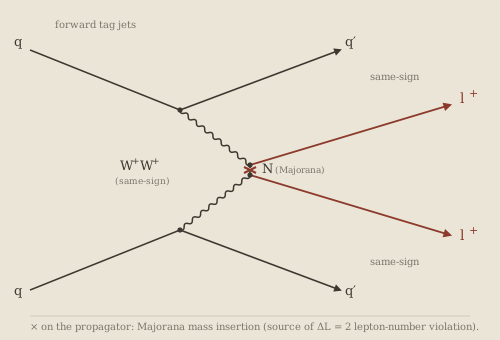
Feynman-style schematic. Two incoming quarks radiate same-sign W bosons that meet at a Majorana neutrino N; the Majorana mass insertion (×) violates lepton number by two units, allowing the final state to carry two same-sign leptons. Same-sign WW scattering is a rare, purely-electroweak process that uniquely tests whether neutrinos are their own antiparticles — at high momentum transfer it is essentially a collider realisation of neutrinoless double-beta decay. This search uses the full ATLAS Run 2 dataset (140 fb⁻¹) in the same-sign dimuon channel to look for heavy Majorana neutrinos with masses from 50 GeV to 20 TeV, pushing the reach past the TeV barrier where resonant production becomes kinematically inaccessible. The results are interpreted in the Phenomenological Type-I Seesaw; a discovery would establish lepton-number violation.
-
Electroweak Collider / ATLAS
-
Published,preprint Angles on CP-violation in Higgs boson interactionsElectroweak Phenomenology
Explainer
CP-violation in the Higgs sector is one of the most direct routes to a Standard-Model explanation of the baryon asymmetry of the universe. ATLAS has reported two CP-sensitive differential measurements of the signed azimuthal angle between forward jets in h+2-jet events, yielding a combined asymmetry of 0.3 ± 0.2 — too coarse alone to identify the underlying physics. This paper interprets that pattern in SMEFT, exposes the blind directions left by inclusive φ_jj alone, and shows that additional CP-sensitive observables combined with phase-space-dependent effects can resolve them. The result is a concrete roadmap for a global CP-aware Higgs coupling analysis reachable with O(100 fb⁻¹) of LHC data.
-
Published,preprint Vector boson scattering: recent experimental and theory developmentsElectroweak Phenomenology Collider / ATLAS
-
Published,preprint Measurements of electroweak Wjj production and constraints on anomalous gauge couplings with the ATLAS detectorElectroweak Collider / ATLAS
Explainer
An ATLAS measurement of the electroweak production of a W boson with two forward, high-mass dijets — the VBS-like topology that probes the triple-gauge-boson vertex (WWZ/WWγ) directly. Combines 4.7 fb⁻¹ of 7 TeV data with 20.2 fb⁻¹ at 8 TeV, providing both fiducial and differential cross-sections of the EW component (separated from strong Wjj production) and using these to set limits on anomalous triple-gauge couplings.
-
Published,preprint Measurement of the cross-section for electroweak production of dijets in association with a Z boson in pp collisions at √s = 13 TeV with the ATLAS detectorElectroweak Collider / ATLAS
Explainer
The first measurement of electroweak Zjj production at 13 TeV — 3.2 fb⁻¹ of early Run 2 data. The EW component is extracted in a fiducial region designed to suppress the dominant QCD Drell-Yan Zjj background, which is itself constrained by a data-driven method. Reports σ^Zjj_EW = 119 ± 16(stat) ± 20(syst) fb above m_jj = 250 GeV and 34 ± 6 ± 6 fb above 1 TeV — both consistent with Standard Model expectations. A first-look 13 TeV benchmark for EW Zjj that later vector-boson- scattering analyses build on.
Recent talks
-
Invited / conference,seminar VBS Heavy Neutral Lepton searchElectroweak Neutrinos
-
Invited / conference,seminar Manchester same-sign WW vector boson scattering plansElectroweak
Related news
- Ernest Rutherford Fellowship, UKRI-STFC “Using the LHC as an electroweak boson collider: a novel laboratory for dark matter, neutrino, and new electroweak phenomena.”
- Marie Curie Intra-European Fellowship, European Commission “A path to understanding: precision studies through Weak Boson Fusion.”
People
Dr. Julia Iturbe
PhD / Postdoctoral Research Associate · 2013–2016
Determination of the electroweak Zjj production cross-section at ATLAS.
ElectroweakCollider physics



Dr. Yaadav Bhauruth
PhD student · 2013–2017
Searches for new heavy gauge bosons in weak boson fusion.
ElectroweakCollider physics
Dr. Aparajita Dattagupta
PhD student (Indiana University) · 2012–2016
Observation of electroweak W+jets production and kinematic tests of vector boson fusion.
ElectroweakCollider physics
Josephine Hall & Lucas Foreman
MPhys students · 2021–22
Doubly-charged Higgs boson searches at the LHC through vector boson fusion.
Collider physicsElectroweak
Mohamed Aly & Ahmed Abdelmotteleb
MPhys students · 2019–20
Feasibility studies and sensitivity estimations for a new search for heavy Majorana neutrinos at the LHC.
Collider physicsElectroweak
Nicola Neophytou & Anthony Wisdom
MPhys students · 2018–19
Indirect searches for extra dimensions at the LHC.
Collider physicsElectroweak

Mohamed Aly
Summer research intern · 2019
Sensitivity studies for new ATLAS searches for heavy sterile Majorana neutrinos.
Collider physicsElectroweak
Likun Xie
Summer research intern · 2017
Quantum-mechanical interference modelling in searches for high mass di-lepton resonances at the LHC.
Collider physicsElectroweak