Research
Publications
Organised as on my CV: papers with significant personal contribution, then journal publications overseen as editorial-board chair or expert reviewer, then conference results. Filter by topic; primary-author papers carry a short explainer. Citation counts are fetched live from INSPIRE-HEP.
Full record including smaller collaborative contributions at INSPIRE-HEP →
Peer-reviewed papers with significant personal contribution
Primary-author publications
2026
-
Published,preprint Construction and characterisation of the DarkSide-20k veto silicon photo-multiplier tilesEur. Phys. J. C (2026), acceptedDark matter Instrumentation
Explainer
Describes the completed production and characterisation of 1920 silicon photomultiplier "veto tile" assemblies — arrays of 24 SiPMs on custom PCBs providing power distribution and signal amplification — for the DarkSide-20k Inner Veto, which discriminates against radiogenic neutron and cosmic muon backgrounds. The Manchester group led the assembly, warm testing, handler design and construction, assembly and testing procedures, and shipping logistics, and contributed to cryogenic testing. Final production yield exceeded 87%, surpassing the 80% requirement, with all tiles confirming stable cryogenic operation, high signal-to-noise ratio, and low radioactive contamination.
2023
-
Published,preprint Search for dark matter particle interactions with electron final states with DarkSide-50Dark matter
Explainer
The companion electron-channel analysis on DarkSide-50's 12 ton-day argon exposure. Ionisation signals from sub-GeV/c² dark matter scattering on atomic electrons constrain four distinct scenarios in one paper: DM-electron elastic scattering, axion-like-particle absorption, dark-photon kinetic mixing — and, for the first time in direct detection, the mixing angle |U_e4|² for keV-scale sterile neutrinos.
-
Dark matter
Explainer
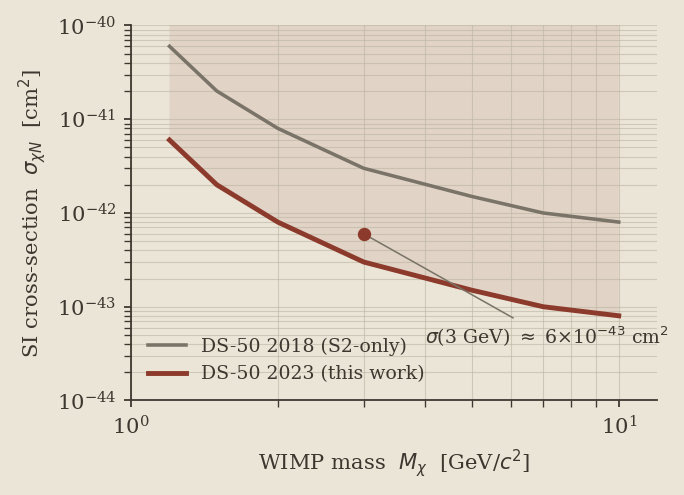
Schematic of the factor-of-ten reach gain. The 2023 limit (oxblood, this work) sits an order of magnitude below the 2018 DarkSide-50 ionisation-only result over [1.2, 10] GeV/c². Coarse pedagogical digitisation, not a publication-grade figure. The legacy DarkSide-50 low-mass WIMP search, on the full 12 ton-day low-radioactivity argon dataset. Improved calibration of the LAr ionisation response, a refined background model and a 0.06 keV_er analysis threshold push the SI cross-section limit at 3 GeV/c² to 6×10⁻⁴³ cm² — a factor-of-10 improvement on the previous DarkSide-50 result — and extend the exclusion region below the previous world best across the [1.2, 3.6] GeV/c² WIMP mass range.
-
Dark matter
Explainer
The Migdal effect — ionization shaken loose when a nucleus recoils — gives a sub-GeV WIMP a detectable electronic signature even when the bare nuclear recoil is well below threshold. This analysis, on DarkSide-50's full 12 306 kg·d low-radioactivity argon exposure using the ionization signal alone, extends the search down to 40 MeV/c² and sets the world-leading spin-independent limit on WIMP-nucleon scattering for masses below 3.6 GeV/c² at the time of publication. Establishes Migdal as a routine sub-GeV channel for argon.
-
Published,preprint Sensitivity projections for a dual-phase argon TPC optimized for light dark matter searches through the ionization channelDark matter Instrumentation
Explainer
Concept design study for DarkSide-LowMass: a ionization-only, electron-counting argon TPC built on the DarkSide-50 legacy and the DarkSide-20k programme, optimised for sub-10 GeV/c² dark matter. The projections show GeV-scale reach down to the solar neutrino fog and — through the Migdal effect or DM-electron scattering — significant sensitivity down to 10 MeV/c². Sets out the threshold, background and spurious-electron control targets a purpose-built low-mass argon experiment would need to hit.
-
Published,preprint Isospin-violating dark matter at liquid noble detectors: new constraints, future projections, and an exploration of target complementarityDark matter Phenomenology
Explainer
Dark matter need not couple equally to protons and neutrons; relaxing that symmetry can move direct-detection limits by orders of magnitude. Earlier studies of isospin-violating dark matter worked in the zero-momentum limit; we extend the treatment to the full non-relativistic effective-field-theory (NREFT) basis and apply it to XENON1T, DarkSide-50, DEAP-3600, LZ and DarkSide-20k. The headline surprise: under the Standard-Model-gauge-invariant formulation of the canonical spin-dependent interaction, argon — a zero-spin nucleus — becomes competitive with xenon, illustrating how strongly target complementarity matters for interpretation.
-
Published,preprint Search for Majorana neutrinos in same-sign WW scattering events from pp collisions at √s = 13 TeVNeutrinos Electroweak Collider / ATLAS
Explainer
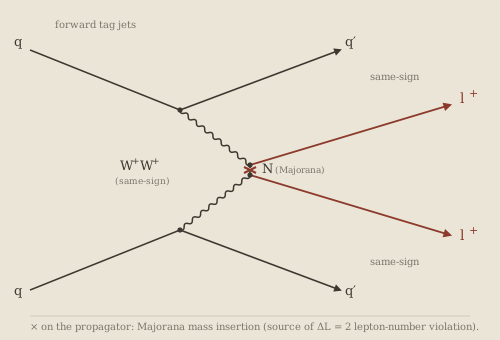
Feynman-style schematic. Two incoming quarks radiate same-sign W bosons that meet at a Majorana neutrino N; the Majorana mass insertion (×) violates lepton number by two units, allowing the final state to carry two same-sign leptons. Same-sign WW scattering is a rare, purely-electroweak process that uniquely tests whether neutrinos are their own antiparticles — at high momentum transfer it is essentially a collider realisation of neutrinoless double-beta decay. This search uses the full ATLAS Run 2 dataset (140 fb⁻¹) in the same-sign dimuon channel to look for heavy Majorana neutrinos with masses from 50 GeV to 20 TeV, pushing the reach past the TeV barrier where resonant production becomes kinematically inaccessible. The results are interpreted in the Phenomenological Type-I Seesaw; a discovery would establish lepton-number violation.
2022
-
Published,preprint Prospects for quarkonium studies at the High-Luminosity LHCQCD B-physics
Explainer
A community roadmap for quarkonium physics at the High-Luminosity LHC, covering pp, pA and AA collisions in both collider and fixed-target modes. Five threads run through it: associated production of J/ψ and Υ with other hard particles; low-pT χ_{c,b} and η_{c,b} spectroscopy; quarkonia as probes of gluon PDFs, nuclear PDFs and the full transverse-momentum-dependent / generalised parton distribution family; the gluon Sivers effect; and quarkonia as a thermometer for the quark–gluon plasma in heavy-ion collisions.
-
Published,preprint Learning to discover: expressive Gaussian mixture models for multi- dimensional simulation and parameter inference in the physical sciencesAI / ML Phenomenology
Explainer
An auto-regressive Gaussian-mixture density model designed for problems where the observables have hard physical boundaries and depend conditionally on external (theory) parameters — two features that defeat most off-the-shelf generative models. Projecting onto a configurable latent space gives the network enough expressive power to (a) constrain physical parameters from data, (b) sample as a Monte-Carlo surrogate, and (c) estimate likelihood ratios for event classification, all from one trained model. Demonstrated on anomalous electroweak Z+jj production at the LHC.
2021
-
Published,preprint Search for new phenomena in final states with b-jets and missing transverse momentum in √s = 13 TeV pp collisions with the ATLAS detectorDark matter Collider / ATLAS
Explainer
A full Run 2 ATLAS search (139 fb⁻¹) in the b-jets + missing transverse momentum final state, simultaneously interpreted in three well-motivated BSM scenarios: pair-produced bottom squarks decaying to b + neutralino; pair-produced dark-matter particles via a generic scalar or pseudoscalar mediator radiated off b-quarks; and pair-produced third-generation down-type scalar leptoquarks. No excess seen — the headline limit excludes bottom squarks below 1270 GeV at 95% CL for a massless neutralino, with the dark-matter and leptoquark reinterpretations setting the strongest LHC bounds in this channel at publication.
2020
-
Published,preprint Reinterpretation of LHC results for new physics: status and recommendations after Run 2Phenomenology Collider / ATLAS Open data
Explainer
The flagship report of the LHC Reinterpretation Forum, audited against Run 2. Covers four dimensions of making LHC results reusable against future theories: how direct searches publish their results, how unfolded measurements are made available, what technical implementations and Open Data exist, and which software frameworks (Rivet, Contur, MadAnalysis, CheckMATE, SModelS, …) consume them. Closes with concrete recommendations on what ATLAS, CMS and LHCb should publish per analysis — recommendations that have since shaped the experiments' release practice.
-
proceedings Expressive density models for high energy physics using a custom latent spaceNeurIPS 2020 ML4PS Workshop (peer-reviewed)AI / ML Phenomenology
Explainer
Builds high-capacity density models for high-energy physics by designing a custom latent space tailored to the structure of physical observables, improving on generic deep generative architectures for simulation and inference.
2019
-
Published,preprint Angles on CP-violation in Higgs boson interactionsElectroweak Phenomenology
Explainer
CP-violation in the Higgs sector is one of the most direct routes to a Standard-Model explanation of the baryon asymmetry of the universe. ATLAS has reported two CP-sensitive differential measurements of the signed azimuthal angle between forward jets in h+2-jet events, yielding a combined asymmetry of 0.3 ± 0.2 — too coarse alone to identify the underlying physics. This paper interprets that pattern in SMEFT, exposes the blind directions left by inclusive φ_jj alone, and shows that additional CP-sensitive observables combined with phase-space-dependent effects can resolve them. The result is a concrete roadmap for a global CP-aware Higgs coupling analysis reachable with O(100 fb⁻¹) of LHC data.
2017
-
Published,preprint Measurements of electroweak Wjj production and constraints on anomalous gauge couplings with the ATLAS detectorElectroweak Collider / ATLAS
Explainer
An ATLAS measurement of the electroweak production of a W boson with two forward, high-mass dijets — the VBS-like topology that probes the triple-gauge-boson vertex (WWZ/WWγ) directly. Combines 4.7 fb⁻¹ of 7 TeV data with 20.2 fb⁻¹ at 8 TeV, providing both fiducial and differential cross-sections of the EW component (separated from strong Wjj production) and using these to set limits on anomalous triple-gauge couplings.
-
Published,preprint Measurement of the cross-section for electroweak production of dijets in association with a Z boson in pp collisions at √s = 13 TeV with the ATLAS detectorElectroweak Collider / ATLAS
Explainer
The first measurement of electroweak Zjj production at 13 TeV — 3.2 fb⁻¹ of early Run 2 data. The EW component is extracted in a fiducial region designed to suppress the dominant QCD Drell-Yan Zjj background, which is itself constrained by a data-driven method. Reports σ^Zjj_EW = 119 ± 16(stat) ± 20(syst) fb above m_jj = 250 GeV and 34 ± 6 ± 6 fb above 1 TeV — both consistent with Standard Model expectations. A first-look 13 TeV benchmark for EW Zjj that later vector-boson- scattering analyses build on.
-
Dark matter Collider / ATLAS Electroweak
Explainer
An early ATLAS Run 2 (3.2 fb⁻¹) measurement built around an experimentalist-friendly idea: report the ratio R_miss = σ(jets + MET) / σ(jets + ℓ⁺ℓ⁻), in which most systematic uncertainties cancel. The ratio is measured differentially in two phase-space regions — an inclusive single-jet region and a VBF-enhanced dijet region — and the unfolded data are designed to be reinterpreted against any future BSM hypothesis. The accompanying analysis constrains simplified DM models, EFT operators and invisible Higgs decays. The first ATLAS measurement of its kind, and a template for reusable, model-agnostic BSM searches at colliders.
2016
-
Published,preprint Measurement of the differential cross-sections of prompt and non-prompt production of J/ψ and ψ(2S) in pp collisions at √s = 7 and 8 TeV with the ATLAS detectorB-physics QCD Collider / ATLAS
Explainer
Comprehensive double-differential cross-sections (in pT and rapidity) for prompt and non-prompt J/ψ and ψ(2S), using 2.1 fb⁻¹ of 7 TeV and 11.4 fb⁻¹ of 8 TeV ATLAS data via the dimuon channel. Reports the ψ(2S)-to-J/ψ production ratio and the non-prompt fraction across kinematic phase space, separating the QCD-driven prompt component from the b-hadron decay contribution. The benchmark reference for quarkonium production theory at LHC Run 1 energies.
2015
-
Published,preprint Observation and measurements of the production of prompt and non-prompt J/ψ mesons in association with a Z boson in pp collisions at √s = 8 TeV with the ATLAS detectorB-physics QCD Collider / ATLAS
Explainer
First observation of associated Z + J/ψ production at >5σ in both the prompt and non-prompt channels, using ATLAS's full 20.3 fb⁻¹ of 8 TeV data. The cross-section ratios relative to inclusive Z are reported as σ(Z + prompt J/ψ)/σ(Z) ~ 4 × 10⁻⁶ and σ(Z + non-prompt J/ψ)/σ(Z) ~ 7 × 10⁻⁶, and the double-parton-scattering component is separated to give a lower bound on σ_eff > 5.3 mb at 68% CL — a direct experimental handle on multi-parton interactions in the proton.
2014
-
Published,preprint Measurement of the production cross-section of prompt J/ψ mesons in association with a W boson in pp collisions at √s = 7 TeVB-physics QCD Collider / ATLAS
Explainer
First observation of W + prompt J/ψ associated production at a hadron collider (5.1σ, 27 ± 7 events) in 4.5 fb⁻¹ of ATLAS 7 TeV data. The cross-section is reported as a ratio to inclusive W production, and a double-parton-scattering contribution is explicitly extracted — providing a clean handle on the σ_eff governing multi-parton interactions in the proton and a sharp test of charmonium production in the presence of an electroweak boson.
-
Published,preprint Measurement of χc1 and χc2 production with √s = 7 TeV pp collisions at ATLASB-physics QCD Collider / ATLAS
Explainer
Differential measurements of χ_c1 and χ_c2 production at the LHC in 4.5 fb⁻¹ of 7 TeV ATLAS data. The χ_c states are reconstructed via the radiative decay χ_c → J/ψ γ using photons from conversions in the inner detector — a technique that gives the resolution needed to separate the two closely-spaced states. Both prompt and non- prompt cross-sections are extracted, the σ(χ_c2)/σ(χ_c1) ratio is measured as a function of J/ψ pT, and the contribution from χ_c feed-down to prompt J/ψ is derived. Key inputs to NRQCD tests of charmonium production.
-
Published,preprint Measurement of the muon reconstruction performance of the ATLAS detector using 2011 and 2012 LHC pp collision dataInstrumentation Collider / ATLAS
Explainer
The ATLAS muon-reconstruction performance paper for Run 1 (2011-12, 7 and 8 TeV), calibrated on large J/ψ → μμ, Z → μμ and Υ → μμ reference samples. Reports muon-reconstruction efficiency above 99% with per-mille precision across |η| < 2.7 and 5 < pT < 100 GeV, and momentum resolution from 1.7% (central, pT ≈ 10 GeV) to 4% (large rapidity, pT ≈ 100 GeV). Provides the simulation corrections used across the entire Run 1 ATLAS physics programme, underpinning B-physics, quarkonium and a broad range of new-physics analyses.
-
Published,preprint Measurement of the production cross-section of ψ(2S) → J/ψ(→μ+μ−)π+π− in pp collisions at √s = 7 TeV at ATLASB-physics Collider / ATLAS
Explainer
Prompt and non-prompt ψ(2S) production at 7 TeV (2.1 fb⁻¹ ATLAS data), using the hadronic decay ψ(2S) → J/ψ(→μ⁺μ⁻)π⁺π⁻. Covers 10 < pT < 100 GeV and |y| < 2.0 — extending the prior dimuon-channel reach to higher transverse momentum and providing an independent cross-check of the colour-singlet, colour-octet and NRQCD descriptions of charmonium production.
2013
-
Published,preprint Measurements of Upsilon production in 7 TeV pp collisions at ATLASB-physics QCD Collider / ATLAS
Explainer
Differential measurements of Υ(1S), Υ(2S) and Υ(3S) production at 7 TeV using 1.8 fb⁻¹ of ATLAS dimuon data, covering pT < 70 GeV and |y| < 2.25. Reports total cross-sections of 8.01, 2.05 and 0.92 nb respectively (assuming unpolarised production), with a quantified polarisation systematic that can shift integrated cross-sections by a factor of two under non-trivial azimuthal dependence. The headline finding: none of the contemporary quarkonium-production models reproduces the data across the full pT range — a clear signal that bottomonium production theory was not yet under control at LHC energies.
-
Published,preprint Studies of W boson plus jets production in pp̄ collisions at √s = 1.96 TeVQCD Collider / ATLAS
Explainer
The legacy DØ Tevatron measurement of inclusive W(→eν) + n-jet (n=1-4) production on 3.7 fb⁻¹ of 1.96 TeV pp̄ data. Reports differential cross-sections across an unusually broad observable set — jet rapidities, lepton kinematics, H_T, leading-dijet pT and invariant mass, opening angles, azimuthal separations, and (the novel ingredient) rapidity separations between both pT-ordered and angular-ordered jet pairs — plus the mean jet multiplicity as a function of H_T. The angular-ordering observables exposed shortcomings in best-of-day predictions and informed parton-shower modelling that fed directly into later LHC W+jets analyses.
2012
-
Published,preprint Observation of a new χb state in radiative transitions to Υ(1S) and Υ(2S) at ATLASB-physics Collider / ATLAS
Explainer
The first observation of a new particle at the Large Hadron Collider, made by ATLAS in 4.4 fb⁻¹ of 7 TeV data. A new structure at m = 10.530 ± 0.005(stat) ± 0.009(syst) GeV is seen in both the Υ(1S)γ and Υ(2S)γ radiative decay channels, identifying it as the χ_b(3P) bottomonium triplet. The result showcased the LHC's reach in heavy-quarkonium spectroscopy, was selected as a PRL Editors' Suggestion, and was confirmed shortly afterwards by DØ in re-analysed Tevatron data.
2011
-
Published,preprint Measurement of the differential cross-sections of inclusive, prompt and non- prompt J/ψ production in pp collisions at √s = 7 TeVB-physics QCD Collider / ATLAS
Explainer
ATLAS's first B-physics publication. On just 2.3 pb⁻¹ of early 7 TeV data, the inclusive J/ψ → μ⁺μ⁻ cross-section is measured double-differentially in pT and rapidity over 1 < pT < 70 GeV and |y| < 2.4 — the widest reach of any J/ψ production measurement at the time. The prompt and non-prompt components are separated via the dimuon pseudo-proper time, and the results are compared against Colour Singlet NNLO*, the Colour Evaporation Model and FONLL. The work laid the groundwork for the LHC's quarkonium-production programme.
-
Published,preprint Measurements of inclusive W+jets production rates as a function of jet transverse momentum in pp̄ collisions at √s = 1.96 TeVQCD Collider / ATLAS
Explainer
The DØ inclusive W(→eν) + n-jet measurement (n = 1-4) on 4.2 fb⁻¹ of 1.96 TeV pp̄ data, presenting cross-sections differentially in the nth-jet pT. Reaches considerably smaller uncertainties than previous W+jets measurements and is compared to NLO pQCD for the n = 1-3 bins and LO pQCD for n = 4. Generally agrees with the predictions but identifies phase-space regions where they fall short — informing later DØ Higgs searches and LHC W+jets analyses.
-
Published,preprint Measurement of the Υ(1S) production cross-section in pp collisions at √s = 7 TeV in ATLASB-physics QCD Collider / ATLAS
Explainer
The first measurement of Υ(1S) production at the LHC — Υ(1S) → μ⁺μ⁻ with 1.13 pb⁻¹ of 7 TeV ATLAS data, presented differentially in pT and in two rapidity bands (|y|<1.2 and 1.2<|y|<2.4). The analysis is designed to minimise sensitivity to the poorly known polarisation by tight muon-pT requirements. The cross-section agrees with NRQCD predictions (colour singlet + colour octet) within a factor of two, but is off by up to an order of magnitude from the NLO colour-singlet-only prediction — a foundational bottomonium-production data point for the LHC programme.
2009
-
Published,preprint Expected performance of the ATLAS experiment — detector, trigger and physicsATLAS ReportsInstrumentation Collider / ATLAS
Explainer
The pre-data ATLAS detector + physics compendium — an 1852-page reference document that, before any 7 TeV collisions had been recorded, surveyed expected reconstruction performance (tracking, leptons, photons, MET, jets, b-tagging, trigger) and projected sensitivity across the planned physics programme. The chapters on low-pT muon reconstruction and quarkonium / heavy-flavour measurements (contributed to here) anchored the early ATLAS B-physics programme.
2008
-
Published,preprint The ATLAS experiment at the CERN Large Hadron ColliderInstrumentation Collider / ATLAS
Explainer
The detector paper for ATLAS — the canonical reference for the experiment's design, construction and performance, with contributions on electron bremsstrahlung-recovery algorithms.
Publications as group convener (not otherwise listed)
Journal publications signed as physics-group convener — coordinated analysis, reviewed and edited
2018
-
Published,preprint Pushing the precision frontier at the LHC with V+jetsarXiv:1802.02100 (workshop report)Electroweak QCD Collider / ATLAS
-
Published,preprint Measurement of quarkonium production in proton–lead and proton–proton collisions at 5.02 TeV with the ATLAS detectorB-physics QCD Collider / ATLAS
-
Published,preprint Search for a structure in the B0sπ± invariant mass spectrum with the ATLAS experimentB-physics Collider / ATLAS
-
Published,preprint Angular analysis of B0d → K*μ+μ− decays in pp collisions at √s = 8 TeV with the ATLAS detectorB-physics Collider / ATLAS
2017
-
Published,preprint Measurements of ψ(2S) and X(3872) → J/ψπ+π− production in pp collisions at √s = 8 TeV with the ATLAS detectorB-physics Collider / ATLAS
-
Published,preprint Measurement of the prompt J/ψ pair production cross-section in pp collisions at √s = 8 TeV with the ATLAS detectorB-physics QCD Collider / ATLAS
-
Published,preprint Measurement of b-hadron pair production with the ATLAS detector in proton- proton collisions at √s = 8 TeVB-physics QCD Collider / ATLAS
2016
-
Published,preprint Study of the B+c → J/ψ Ds+ and B+c → J/ψ Ds*+ decays with the ATLAS detectorB-physics Collider / ATLAS
-
Published,preprint Measurement of D*±, D± and Ds± meson production cross sections in pp collisions at √s = 7 TeV with the ATLAS detectorQCD Collider / ATLAS
-
Published,preprint Measurement of the CP-violating phase φs and the B0s meson decay width difference with B0s → J/ψφ decays in ATLASB-physics Collider / ATLAS
-
Published,preprint Study of the rare decays of B0s and B0 into muon pairs from data collected during the LHC Run 1 with the ATLAS detectorB-physics Collider / ATLAS
-
Published,preprint Measurement of the relative width difference of the B0–B̄⁰ system with the ATLAS detectorB-physics Collider / ATLAS
2015
-
Published,preprint Search for the Xb and other hidden-beauty states in the π+π−Υ(1S) channel at ATLASB-physics Collider / ATLAS
-
Published,preprint Determination of the ratio of b-quark fragmentation fractions fs/fd in pp collisions at √s = 7 TeV with the ATLAS detectorB-physics QCD Collider / ATLAS
-
Published,preprint Measurement of the branching ratio Γ(Λ0b → ψ(2S)Λ⁰)/Γ(Λ0b → J/ψΛ⁰) with the ATLAS detectorB-physics Collider / ATLAS
Editorial-board chair & expert review
Journal publications overseen as editorial-board chair or invited expert reviewer
2022
-
Electroweak Collider / ATLAS
2020
-
Published,preprint Measurement of J/ψ production in association with a W± boson with pp data at 8 TeVB-physics QCD Collider / ATLAS
-
Published,preprint Search for Higgs boson decays into a Z boson and a light hadronically decaying resonance using 13 TeV pp collision data from the ATLAS detectorB-physics Collider / ATLAS
2019
-
Published,preprint Next-generation spin-0 dark matter modelsDark matter Phenomenology
-
Published,preprint Constraints on mediator-based dark matter and scalar dark energy models using √s = 13 TeV pp collisions at the LHC with the ATLAS detectorDark matter Collider / ATLAS
2018
-
Published,preprint Vector boson scattering: recent experimental and theory developmentsElectroweak Phenomenology Collider / ATLAS
2015
-
Published,preprint Measurement of the production and lepton charge asymmetry of W bosons in Pb+Pb collisions at √sNN = 2.76 TeV with the ATLAS detectorElectroweak Collider / ATLAS
2014
-
Published,preprint Search for the X(4140) state in B± → J/ψφK+ decays with the DØ detectorB-physics Collider / ATLAS
2013
-
Published,preprint Measurement of Z boson production in Pb–Pb collisions at √sNN = 2.76 TeV with the ATLAS detectorElectroweak Collider / ATLAS
-
Published,preprint Search for the rare decay B0s → μ+μ−B-physics Collider / ATLAS
2012
-
Published,preprint Observation of a narrow mass state decaying into Υ(1S)+γ in pp̄ collisions at √s = 1.96 TeVB-physics Collider / ATLAS
Conference results & notes
Peer-reviewed conference proceedings and collaboration notes
2020
-
note Review of the 13 TeV ATLAS Open Data releaseATL-OREACH-PUB-2020-001Open data Collider / ATLAS Instrumentation
2019
-
note Study of J/ψ resonances in Λ0b → J/ψpK− decays in pp collisions at √s = 7 and 8 TeV with the ATLAS detectorATLAS-CONF-2019-048B-physics Collider / ATLAS
2016
-
note Production measurements of ψ(2S) and X(3872) → J/ψπ+π− at √s = 8 TeV with the ATLAS detectorATLAS-CONF-2016-028B-physics Collider / ATLAS
-
note Measurement of the prompt J/ψ pair production cross-section in pp collisions at √s = 8 TeV with the ATLAS detectorATLAS-CONF-2016-047B-physics QCD Collider / ATLAS
2015
-
note Differential cross-sections of prompt and non-prompt J/ψ and ψ(2S) at √s = 7 and 8 TeVATLAS-CONF-2015-024B-physics QCD Collider / ATLAS
-
note Measurement of the differential non-prompt J/ψ production fraction at √s = 13 TeV pp collisions at the ATLAS experimentATLAS-CONF-2015-030B-physics QCD Collider / ATLAS
2014
-
note Measurement of W boson production and the lepton charge asymmetry in PbPb collisions at √sNN = 2.76 TeV with the ATLAS detectorATLAS-CONF-2014-023Electroweak Collider / ATLAS
2013
-
note Measurement of the production cross-section of prompt J/ψ mesons in association with a W boson in pp collisions at √s = 7 TeVATLAS-CONF-2013-042B-physics QCD Collider / ATLAS
-
note Measurement of the production cross-section of ψ(2S) → J/ψ(μ+μ−)π+π− in pp collisions at √s = 7 TeV at ATLASATLAS-CONF-2013-094B-physics Collider / ATLAS
-
note Measurement of χc1 and χc2 production with √s = 7 TeV pp collisions at ATLASATLAS-CONF-2013-095B-physics QCD Collider / ATLAS
-
note Measurement of the W → μν charge asymmetry and centrality dependence in Pb+Pb collisions at √sNN = 2.76 TeVATLAS-CONF-2013-106Electroweak Collider / ATLAS
2012
-
proceedings Quarkonium production at ATLASB-physics QCD Collider / ATLAS
-
proceedings W/Z properties and V+jets at the TevatronQCD Collider / ATLAS Electroweak
-
note Scaling properties of Z-boson production in lead-lead collisions at √sNN = 2.76 TeV with the ATLAS detector at the LHCATLAS-CONF-2012-052Electroweak Collider / ATLAS
-
note Measurements in W+jets production at √s = 1.96 TeVDØ Note 6339-CONFQCD Collider / ATLAS
-
note Correlations between Z bosons and jets in 2.76 TeV/nucleon heavy-ion collisions in ATLAS at the LHCATLAS-CONF-2012-119Electroweak QCD Collider / ATLAS
2011
-
proceedings Overview of ATLAS quarkonium results with first dataB-physics QCD Collider / ATLAS
-
proceedings W/Z+jets measurements at DØProc. DIS 2011 (FERMILAB-CONF-11-398-E)QCD Electroweak Collider / ATLAS
-
note Measurements of W boson yields in Pb+Pb at 2.76 TeV/nucleon via single muons with the ATLAS detectorATLAS-CONF-2011-078Electroweak Collider / ATLAS
-
note Observation of the χc1(1P) and χc2(1P) charmonium states in √s = 7 TeV pp collisions at the ATLAS experimentATLAS-CONF-2011-136B-physics QCD Collider / ATLAS
2010
-
proceedings Latest jet results from the TevatronProc. DIS 2010 (FERMILAB-CONF-10-172-E)QCD Collider / ATLAS
-
Proc. ICHEP 2010B-physics QCD Collider / ATLAS
-
note First observation of the J/ψ → μ+μ− resonance in ATLAS pp collisions at √s = 7 TeVATLAS-CONF-2010-045B-physics Collider / ATLAS
-
note A first measurement of the differential cross section for the J/ψ → μ+μ− resonance and the indirect-to-prompt J/ψ cross-section ratio with pp collisions at √s = 7 TeV in ATLASATLAS-CONF-2010-062B-physics QCD Collider / ATLAS
2009
-
Proc. HCP 2009Electroweak Collider / ATLAS
2008
-
Proc. Lake Louise Winter Inst. 2008 (ATL-PHYS-PROC-2008-001)B-physics QCD Collider / ATLAS